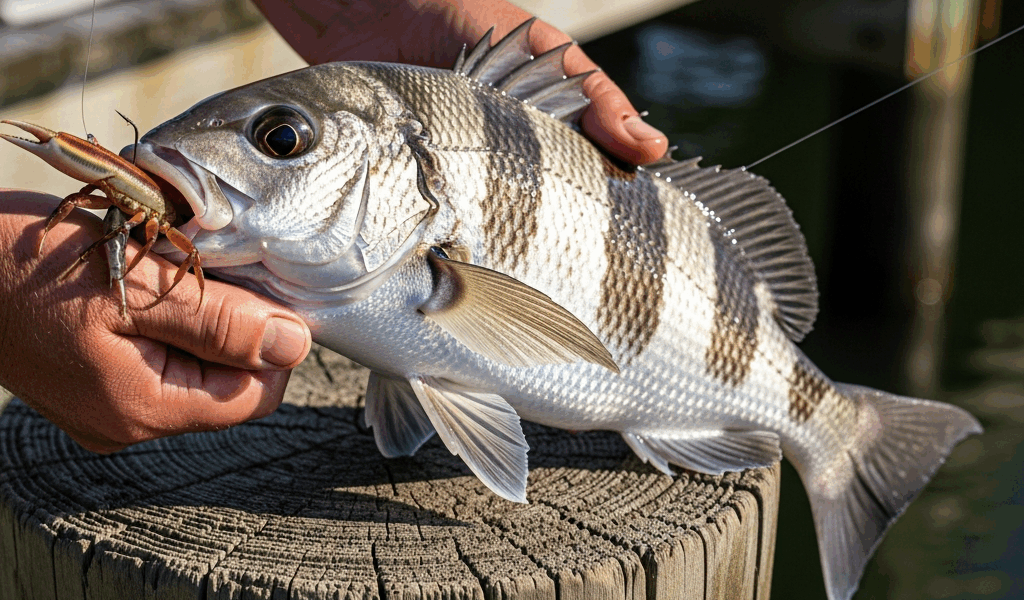
You set the hook and there is nothing there. Again. The bait is gone — completely cleaned off the hook — and you never felt a thing. Welcome to sheepshead fishing, where the fish have human-like teeth, the bite feels like a ghost tapping your line, and the learning curve is the steepest in inshore saltwater. Once you crack the code, though, sheepshead are some of the best table fare swimming.
This article includes affiliate links. We may earn a commission at no extra cost to you.
Why Sheepshead Are So Hard to Hook
Sheepshead have a mouth full of flat, crushing teeth designed for cracking barnacles, oysters, and crabs off pilings and rocks. They do not strike bait like a redfish or trout — they pick at it, crush it, and suck it off the hook with surgical precision. The bite feels like a slight tick, a barely perceptible weight, or nothing at all until you reel in an empty hook.
This feeding behavior means everything about your tackle and technique needs to be optimized for sensitivity. Heavy rods, thick leaders, and large hooks work against you. You need to feel what the fish is doing, and you need a hook small enough that the sheepshead takes it along with the bait instead of stripping the bait around it.
The Right Bait: What Sheepshead Actually Eat
Fiddler crabs are the gold standard for sheepshead bait. They are small, tough, and irresistible to sheepshead. Hook them through the body from bottom to top, avoiding the claws — a fiddler crab that can still move its legs is more attractive than a dead one. Catch your own near oyster beds and mudflats, or buy them at bait shops in sheepshead territory.
Live shrimp work well and are easier to find than fiddler crabs. Thread the shrimp on the hook through the tail — not the head — so it stays alive and moves naturally. Sheepshead are bait inspectors. A dead, limp shrimp gets less attention than a live one that is trying to escape.
Barnacles and oysters scraped off pilings create both chum and bait. Scrape a piling into the water to get sheepshead feeding in the area, then put a piece of barnacle or oyster meat on your hook and drop it into the chum trail. This is the most effective technique for dock and pier fishing — the chum brings the fish, the bait on the hook catches them.
Sand fleas work during surf fishing for sheepshead around jetties and rock groins. Hook them through the hard shell from bottom to top. They are free if you catch them in the wash, which is half the fun.
Tackle Setup: Small, Sharp, Sensitive
The right setup for sheepshead is counter to most saltwater fishing instincts. You need to downsize everything.
Hook: #1 or #2 J-hook, short shank, needle-sharp. Bigger hooks let sheepshead eat around the hook. Smaller hooks embed in the bait and get taken with it. Circle hooks work but J-hooks give you more control on the hookset timing, which matters when the bite is this subtle. Sharpen your hooks before every session — dull hooks slide off sheepshead’s hard mouth. The Gamakatsu Octopus hooks in size #1 or #2 are needle-sharp out of the package and hold a point well through multiple fish.
Rod: 7-foot medium-light fast action spinning rod. You need the sensitivity to feel a bite that most anglers would miss on a heavier rod. Fast action concentrates the flex in the tip, which telegraphs even light contact. Medium-light power is enough for fish that average 3 to 5 pounds — sheepshead fight hard for their size but they are not running 100 yards of drag.
Line: 10 to 15-pound braided mainline with a 15 to 20-pound fluorocarbon leader, 18 to 24 inches long. Braid transmits the bite directly to your rod tip with zero stretch — essential for detecting the sheepshead’s soft take. Fluorocarbon leader is invisible in water and abrasion-resistant against the pilings and rocks where sheepshead live.
Rig: A simple knocker rig — egg sinker sliding directly on the leader above the hook — keeps your bait tight to the bottom where sheepshead feed. The sliding sinker lets the fish pick up the bait without feeling resistance. Weight: 1/2 to 1 ounce depending on current. Enough to stay on the bottom, light enough that the fish does not drop the bait when it feels weight.
Detecting and Setting the Hook
This is where sheepshead fishing is won or lost. The bite is not a thump or a run — it is a light tick, a barely perceptible tightening, or just the feeling that something changed. With practice, you learn to distinguish between the current bumping your sinker and a sheepshead picking at your bait. It takes time. Expect to lose a lot of bait while you calibrate.
Hold the rod tip slightly elevated and maintain light tension on the line. When you feel the tick — and sometimes it is more of a feeling than a physical sensation — reel down smoothly until you feel weight, then set the hook with a firm upward snap. Not a massive hookset like you would use for tarpon — a controlled, sharp set that drives the small hook into the hard mouth.
The common mistake is setting the hook too late. By the time you feel a obvious pull, the sheepshead has already stripped your bait and is spitting the hook. Set the hook on suspicion. You will miss some. You will also catch sheepshead that you never would have hooked waiting for a textbook bite. The old sheepshead saying holds true: set the hook just before you feel the bite.
Where to Find Them
Sheepshead live on structure — specifically structure covered in barnacles, oysters, and crabs. Dock pilings, bridge pilings, rock jetties, oyster bars, and artificial reefs are the primary spots. The fish hover next to the structure and pick food off the surface. Your bait needs to be within inches of the structure to be in the strike zone.
Winter and early spring (December through March in the Gulf and Southeast Atlantic) concentrate sheepshead near nearshore structure as they stage for spawning. This is peak season — the fish are concentrated, actively feeding, and larger specimens show up. Water temperatures in the 55 to 65 degree range are prime.
Fish the pilings on the upcurrent side. Sheepshead face into the current and wait for food to drift toward them. Drop your bait on the upcurrent side of the piling, let it settle, and keep it tight. If you are not losing tackle to the structure occasionally, you are not fishing close enough.


Stay in the loop
Get the latest saltwaterspots.com updates delivered to your inbox.