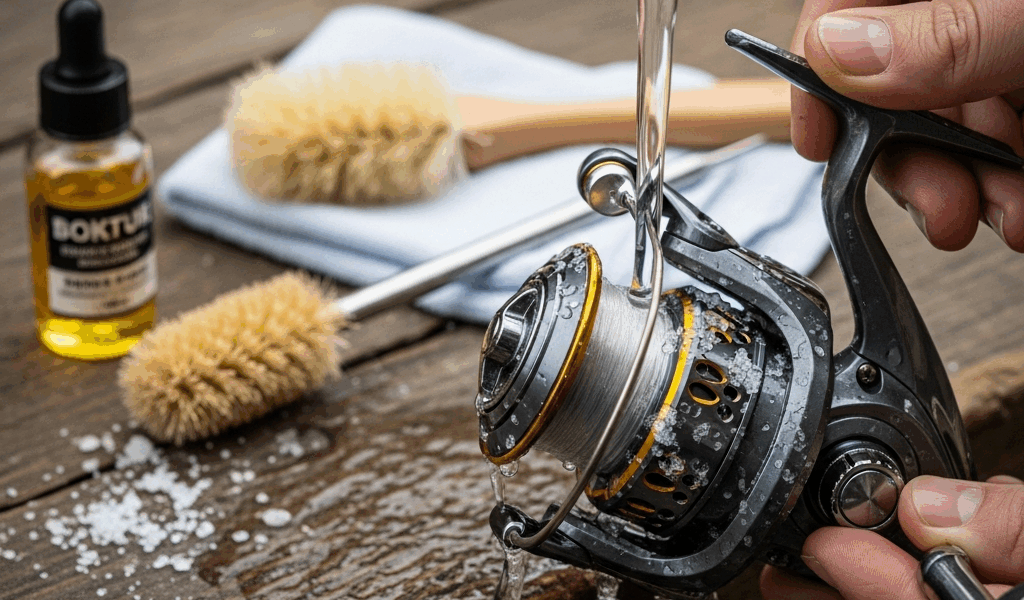
The 5-Minute Post-Trip Rinse Protocol — How to Clean a Saltwater Fishing Reel After Use
As someone who’s been servicing my own saltwater reels for fifteen years, I learned everything there is to know about how to clean a saltwater fishing reel after use by making nearly every mistake in the book. Today, I will share it all with you. The biggest blunder I made early on? Blasting the spool with a garden hose at full pressure. I genuinely thought force equaled cleanliness. It doesn’t.
Here’s what actually works. Within an hour of leaving the water, grab a bucket of warm fresh water — not hot, just warm enough to hold your hand in comfortably. Warm water dissolves salt residue faster than cold. Hot water, though? It warps plastic components and wrecks certain seals. Don’t make my mistake.
Dunk the entire reel into the bucket. Spool orientation matters here — keep the reel handle facing up. Submerge it handle-down and saltwater gets trapped inside the gear housing with nowhere to go. Handle up creates a natural exit path for trapped brine. Simple physics, big difference.
Let it sit for thirty seconds. While it soaks, work the handle slowly — backward, then forward. Don’t crank aggressively. Slow, deliberate rotations let fresh water work into the internal mechanisms without driving debris deeper into the gear train. Ten to fifteen rotations. That’s it.
Now the part most anglers blow past: the line roller. This tiny component gets ignored until it seizes or corrodes — usually right before a tournament, in my experience. Pull the bail open manually and rotate the roller against the line itself. You’re essentially using your fishing line as a brush. It dislodges salt crystals packed into the roller’s bearing.
Drain the bucket. Refill it with fresh water and run the whole soak-and-crank process one more time. On the second pass, the water should stay noticeably clearer. Still cloudy after round two? Go for a third. Salt doesn’t always surrender quickly.
After the final rinse, hold the reel handle-down over a towel and work the handle backward — backward, not forward — to push out excess water. The reverse direction opens internal passages that trap moisture. Pat the exterior dry with a microfiber cloth. Let the reel sit for thirty minutes before putting it away.
Probably should have opened with this section, honestly. Most anglers skip all of it. They believe a quick garden hose spray counts as maintenance. It doesn’t. Salt crystals need time to dissolve. They need warm water. They need gentle agitation, not raw pressure.
This article includes affiliate links. We may earn a commission at no extra cost to you.
Monthly Deep Clean for Serious Saltwater Anglers — Drag Stack Service and Bearing Lubrication
Do the five-minute rinse after every trip. Do this monthly deep clean once a month during heavy fishing seasons — quarterly if you’re fishing casually. Those are the two rhythms. Stick to them.
Start by backing the drag off completely. Loosen the drag knob until it spins freely with almost zero resistance. Then find the spool retaining nut — the large nut holding the spool in place. On most baitcasters, you’ll need a spool wrench. On spinning reels, it’s usually something you can turn by hand or with a small adjustable wrench.
Pull the spool off entirely. Now you’re looking at the drag stack — a series of washers and friction plates stacked on the spool shaft. Depending on reel size, you’ll count four to eight components. Pull each one out and lay them in sequence on a clean towel. Order matters here. Remember that.
Soak the drag components in warm fresh water for five minutes. Use a soft-bristled brush — an old toothbrush is perfect — and gently scrub each washer. I’m apparently a diluted white vinegar person when it comes to stubborn salt deposits, and it works for me while plain water alone never quite cuts it on older buildup. Adds about five minutes. Worth it.
Dry everything thoroughly. Moisture destroys drag performance. Compressed air is ideal — I use a $35 electric inflator from Harbor Freight that pulls double duty — or just air-dry under a fan for ten minutes.
Before reassembling, handle the bearing lubrication. Locate the small bearings on the spool shaft — small metal components, hard to miss once the spool is off. Apply one tiny drop of Corrosion-X or Cal’s Universal Reel Lube to each bearing. One drop. Literally one. I run Corrosion-X on all my reels because it displaces moisture and fights corrosion at the same time. Cal’s runs heavier and performs better specifically on drag stack components.
Reassemble the drag stack in reverse order. Get the sequence right. Stack order matters — mix it up and drag performance becomes unpredictable in ways that are genuinely maddening to diagnose mid-session.
The line roller needs attention here too. If your reel has a removable roller, pull it out. Clean it with the same warm water rinse and a small brush. One drop of reel lube on the center bearing. Some models have sealed line rollers that can’t be removed — on those, just apply lube around the edges where the bearing sits.
Spin the spool by hand a few times. Smooth rotation with no grinding. If you hear grinding, something went sideways during reassembly. Stop. Take it apart and check the stack order again.
Seasonal Overhaul — When Your Reel Needs Real Service
Two or three times per year — fall, spring, maybe midsummer depending on your schedule — your reel needs a genuine teardown. This isn’t a deep clean. This is full disassembly.
While you won’t need a full machine shop, you will need a handful of specific tools: a clean workspace, small labeled containers for screws, and probably a reel manual. Daiwa, Shimano, Abu Garcia, Penn — all of them publish service diagrams online or in PDF format. Download yours before you start.
First, you should remove every external screw from the housing — at least if you want to actually access the gear train. Place each one in a labeled container immediately. I use a muffin tin, one cup per screw size. Losing a single screw means the reel won’t reassemble with a proper seal. That was a $200 lesson I learned on a Penn Torque. That was 2014.
Separate the spool housing from the frame. The gear train is now visible. Corrosion damage shows up most obviously here. White crystalline buildup on the gears means salt has bonded to the metal. Black or brown means oxidation has started — that’s a more urgent situation.
Minor white residue? Warm water and a soft brush handles it. Deep pitting or significant corrosion? Send the reel to the manufacturer. A corroded pinion gear runs $60 to $80 to replace. Professional service on a damaged reel runs $90 to $150 depending on the model. Catching it early is always cheaper.
For seasonal maintenance without damage present, clean all gears with warm water and a brush. Apply a thin layer of reel grease — specifically reel grease, not general-purpose grease from the garage shelf — to the gear teeth. Shimano Grease DG06 is what I use on my Stellas. Daiwa makes their own formulation. Penn runs proprietary. Match the grease to the brand. Wrong grease either gums up or starts attracting sand particles. Neither outcome is acceptable.
Lubricate the main shaft bearing where it rotates through the frame. One drop of Corrosion-X. Not more. Excess oil acts like a magnet for salt particles and sand.
Check the bail spring on spinning reels. But what is a bail spring, exactly? In essence, it’s the small metal arm that snaps the bail closed with authority. But it’s much more than that — it’s the component that determines whether your cast actually completes cleanly. A spring that moves slowly or hesitates has weakened. Order the replacement part from the manufacturer before it fails during a cast.
Reassemble everything in reverse. Screws go back to their original locations — a larger screw in a smaller hole creates a weak seal that invites moisture into the housing.
Spinning vs. Conventional — Different Maintenance Needs
Spinning reels and conventional baitcasters corrode differently. That’s what makes understanding your specific setup so important to us saltwater anglers. Knowing where each design fails lets you prioritize the right maintenance at the right time.
Spinning reels take the most damage at the bail mechanism. The bail roller — the small wheel the line rides across — sits fully exposed to direct saltwater spray. This component needs attention after every trip, not monthly. Remove it if your model allows, soak it, and lubricate it immediately. High-end reels like the Shimano Stella FK have sealed bail rollers that don’t require removal. Entry-level spinning reels typically have exposed rollers that absolutely do.
Salt deposits build up under the bail spring base. Work a toothbrush under there during monthly cleanings. When bail closure starts feeling sluggish, replace the spring assembly before it fails during a cast — not after.
Conventional reels fail in different places. The level wind mechanism — the small guide that distributes line evenly across the spool — moves constantly during casting and retrieval. Salt accumulates in the level wind bearing fast. During monthly service, pull the level wind completely, soak all components, and check the bearing for early corrosion.
The pinion gear on conventional reels absorbs more punishment than anything in a spinning reel. Conventional anglers generate higher torque during retrieval, which accelerates wear. Inspect pinion gears closely every seasonal overhaul. Light surface corrosion is expected. Deep pitting means you’re already behind.
So, without further ado, let’s be direct: both reel types follow the same basic maintenance calendar. Monthly drag and bearing service. Seasonal complete disassembly. But paying specific attention to each design’s weak points is what actually prevents a failure when you’re into fish.
Storage Between Seasons — Backing Off Drag and Climate Control
How you store reels during the off-season determines whether they last three years or fifteen. It really is that binary.
First, you should back the drag off completely — at least if you want consistent drag performance when the season opens again. A drag stack under constant tension for months develops permanent set. The friction material compresses and never fully recovers. I pulled a reel out of storage in spring 2018 with the drag locked at full tension all winter. The smoothness was gone. Completely gone.
Wipe down the entire reel exterior with a very light coat of Corrosion-X or a basic 3-in-1 oil applied with a microfiber cloth. A cloth that’s slightly damp with oil is correct. A reel that looks visibly shiny is over-oiled. You’re protecting metal from ambient moisture — not building a waterproof coating.
Climate-controlled storage might be the best option, as off-season reel longevity requires temperature stability above almost everything else. That is because a garage cycling between freezing winters and 100-degree summers creates expansion and contraction that loosens seals and drives moisture deeper into the housing. An air-conditioned closet is ideal. A climate-controlled storage unit works. A detached garage does not.
Use rod cases or reel socks. Rod cases keep reels from resting against hard surfaces. Reel socks — fabric bags, $5 to $8 each — let the reel breathe while blocking dust. Store with the rod handle pointing down. That orientation prevents condensation from settling into the gear housing.
Check stored reels every three months, even during off-season. Rotate the handle backward ten times. Work the drag a few cycles. You’re verifying nothing has seized up inside. A reel that sits untouched for eight months and freezes up may need professional service to recover — and that’s assuming no permanent damage occurred.
Before the season restarts, run a complete monthly deep clean. Don’t assume storage went smoothly. Moisture finds a way in despite your best efforts. A pre-season service catches early corrosion before it becomes an expensive problem.
Saltwater reels demand respect. They demand consistent attention. But they reward that attention with years of reliable, smooth performance. I’ve got Shimano Stradic CI4+ reels I bought in 2009 that cast and drag as cleanly as they did out of the box. That’s not luck. That’s maintenance discipline — and now you have the full picture.

Stay in the loop
Get the latest saltwaterspots.com updates delivered to your inbox.