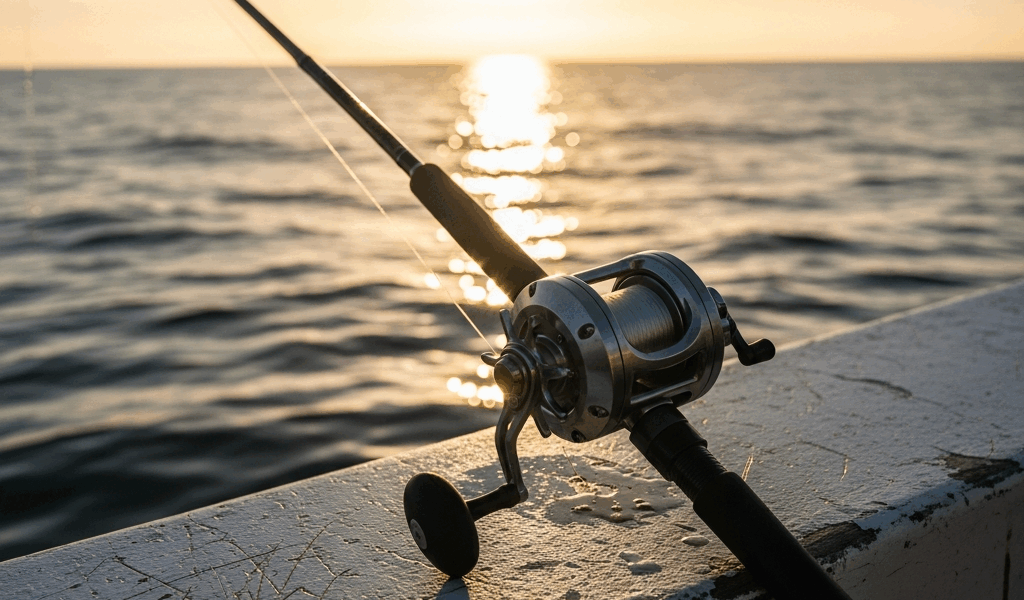
You are standing in a tackle shop staring at a wall of rods from 6 feet to 9 feet long, light action to heavy, and the guy behind the counter just asked what species you are targeting. The right answer depends on where you fish, what you are casting, and what is likely to eat it. Here is the practical breakdown by species and technique so you walk out with a rod that actually matches your fishing.
Why Rod Size Matters in Saltwater
Rod length and power are not about personal preference — they determine casting distance, lure control, hookset power, and how much leverage you have against a fish that does not want to come to the boat. A rod that is too light for the species means lost fish and broken tackle. A rod that is too heavy kills the fight and makes casting exhausting.
Length controls casting distance and leverage. Longer rods cast farther and give you more leverage for controlling fish at distance. Shorter rods provide more power and accuracy for close-quarters fishing, jigging, and fighting large fish straight underneath the boat.
Power (light, medium, medium-heavy, heavy) describes how much force it takes to bend the rod. Action (fast, moderate, slow) describes where the rod bends. Fast action bends in the top third — sensitive and responsive. Moderate action bends through the middle — more forgiving, better for treble-hook lures. The combination of power and action defines what the rod does well.
Inshore Species: Redfish, Speckled Trout, Flounder
Inshore saltwater covers the flats, marshes, jetties, and nearshore structure where most saltwater anglers spend their time. The fish are 2 to 15 pounds in most cases, the lures are light, and you are often sight-casting or making accurate casts to structure.
Recommended rod: 7-foot medium or medium-light power, fast action spinning rod. This length gives you enough casting distance for open flats and enough accuracy for casting next to dock pilings and mangrove edges. Medium power handles 15-pound redfish without being overkill for 2-pound speckled trout.
For sight-casting on shallow flats, a 7-foot to 7-foot-6-inch medium-light fast action rod gives you the sensitivity to detect subtle takes and the finesse to present soft plastics naturally. Redfish eat gently on the flats — a heavy rod masks the take and you miss fish.
For jetty and structure fishing where larger redfish and black drum show up, step up to a 7-foot medium-heavy fast action rod. You need the backbone to turn a fish away from barnacle-covered rocks before it cuts your line.
Nearshore Species: Snook, Tarpon, Jack Crevalle
Nearshore predators are bigger, stronger, and fight harder than typical inshore species. Snook run 5 to 25 pounds. Juvenile tarpon hit 20 to 60 pounds. Jack crevalle are pure aggression at any size. The rod needs more backbone without losing casting ability.
Recommended rod: 7-foot to 7-foot-6-inch medium-heavy fast action spinning rod for snook and jacks. Heavy power fast action for tarpon over 30 pounds. Switch to a conventional (baitcasting) reel setup for tarpon fishing — the drag system on conventional reels handles sustained runs better than most spinning reels at this weight class.
Snook fishing around bridges and mangroves requires a rod with enough power to turn the fish away from structure immediately after the hookset. A medium rod gets wrapped around a piling. A medium-heavy rod gives you the authority to steer a 15-pound snook away from the obstacle that will cut you off.
Offshore Species: Mahi, Kingfish, Grouper
Offshore fishing changes the equation. You are dealing with bigger fish, heavier tackle, deeper water, and often trolling or bottom-dropping rather than casting. Rod selection shifts toward power and durability.
Trolling for mahi and kingfish: 6-foot to 6-foot-6-inch medium-heavy to heavy power conventional rod. Shorter length gives you leverage for fighting fish at the rail. Heavy power handles the sudden strike-and-run of a kingfish or the aerial acrobatics of a mahi without risking a break. Pair with a conventional reel rated for 20 to 30-pound line.
Bottom fishing for grouper and snapper: 6-foot to 6-foot-6-inch heavy power fast action conventional rod. Grouper dive into structure the instant they feel the hook. You need a rod with zero flex to haul them away from the reef before they lock themselves in a rock crevice. This is pure power fishing — finesse does not apply.
Casting for mahi at the boat: a 7-foot medium-heavy spinning rod lets you pitch live bait or chunk bait to mahi holding behind the boat. Faster action means better sensitivity for detecting the take, and medium-heavy power handles fish up to 30 pounds without being unwieldy.
Surf Fishing: A Category of Its Own
Surf fishing demands length above all else. You are casting over breaking waves and through wind, and short rods cannot reach the troughs and cuts where fish feed.
Recommended rod: 9-foot to 11-foot medium to medium-heavy power moderate action spinning rod. The length generates casting distance — an 11-foot rod throws bait 30 to 50 feet farther than a 7-foot rod. Moderate action loads the rod during the cast, building energy through the flex that launches the weight. Fast action surf rods do not load as efficiently and sacrifice casting distance.
For targeting pompano and whiting in the wash, a 9-foot medium power rod handles the lighter tackle and smaller fish. For targeting bull reds, sharks, and larger surf species, step up to a 10 to 11-foot medium-heavy rod that can handle 6-ounce sinkers and 50-pound fish in heavy surf.

Stay in the loop
Get the latest saltwaterspots.com updates delivered to your inbox.