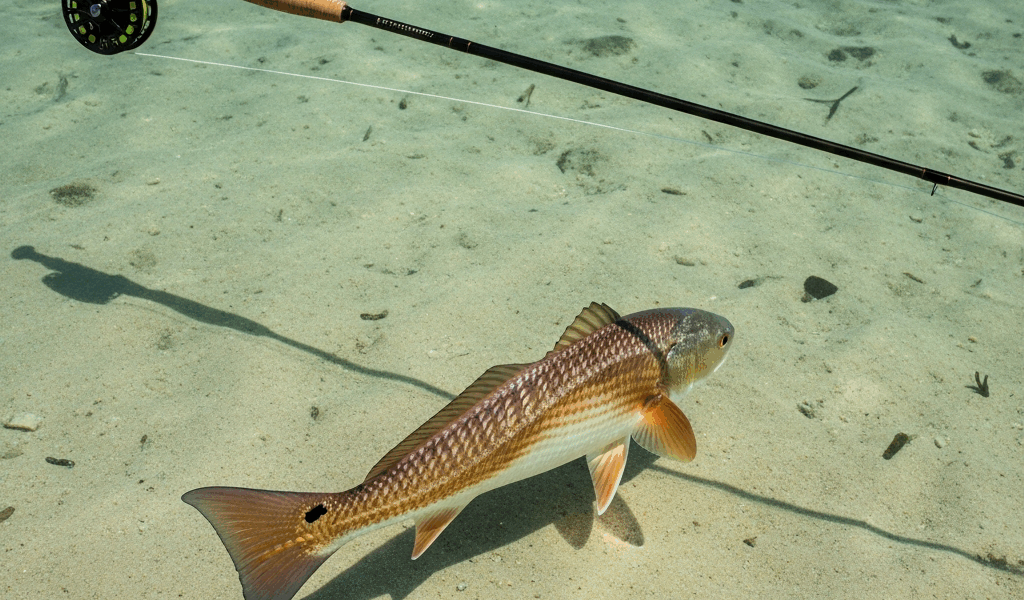
Redfish in Shallow Water Are Already on Edge
Shallow water redfish have gotten complicated with all the bad advice flying around about why they keep spooking.
Here’s what nobody tells you upfront: a redfish sitting in eighteen inches has exactly zero escape options except sideways — fast. Fish in four feet can drop down and disappear. Fish in skinny water can’t. Their lateral line, that sensory strip running the length of their body, goes into overdrive when depth disappears. Every pressure change, every shadow, every vibration reads as a predator closing in. A shadow crossing their nose isn’t just darkness passing over. It’s a signal that something large enough to block sunlight is close enough to matter.
I learned this the hard way on the Laguna Madre — a brutal March morning where I watched red after red spin and bolt before my lure ever touched the water. Couldn’t figure it out for the first two hours. I was fishing like I had four feet beneath me when everything visible was pushing eighteen inches, maybe less. That’s not a small miscalculation. That’s the difference between a nervous fish and a completely terrified one.
Probably should have opened with this section, honestly. Understanding why shallow redfish spook is the only reason the rest of this diagnosis matters. They’re not being difficult. They’re surviving. Your job is to interrupt that survival instinct before flight triggers — and that means knowing exactly where their alarm system fires.
Your Shadow or Wake Is Hitting Them First
The sun doesn’t care about your cast. Your shadow absolutely does.
Position yourself so the sun is at your back and the fish is looking toward the light — not at your silhouette cutting across their visual field. Redfish eyes sit on the sides of the head. Nearly 360-degree vision. There’s a blind spot directly behind them, but forward and upward? They see everything. Stand with the sun behind the fish and you’ve painted yourself across their entire awareness before you’ve even started your approach.
This makes morning and evening presentations matter more than most anglers realize. A 9 a.m. sun low in the east gives you a workable window approaching from the west. Noon actually helps — high sun shrinks shadows considerably. Late afternoon flips it again. Keep track of where you are relative to that light.
Wade push is equally ruthless, and this one took me forever to accept. Moving through shallow water creates a pressure wave that travels faster than your body does. A redfish thirty feet out will feel that wave before it ever sees you. I used to think wading slow fixed the problem. It doesn’t — not really. What actually works is maintaining thirty to forty feet minimum in water under two feet. Fifty feet is better. At that distance the wave disperses before it reaches anything feeding.
Boat positioning demands the same discipline. Poling a skiff or running a kayak — same math applies. Set your approach so the boat sits between you and where the fish will bolt. Most redfish flush toward deeper water, which is generally behind them relative to sun angle. Come in from the side or upwind. Give yourself an exit that doesn’t cross directly through the fish’s escape line.
The Lure Entry Is Too Loud for Flat Water
Splash control in eighteen inches of water isn’t a suggestion. It’s the whole ballgame.
A 1/8-ounce jig head dropping hard into glass-calm conditions sounds like a dinner bell — a bad one. That concussive impact moves through thin water fast and registers as either a threat or evidence that something bigger just struck nearby. The redfish panics before your lure even begins to settle. That’s what makes skinny water so unforgiving to the rest of us fishing it.
Drop to lighter jig heads whenever you’re in under eighteen inches. A 1/16-ounce head paired with a 2.5-inch soft plastic — something like a Gulp! Shrimp or a Z-Man Slim SwimZ — enters the water with dramatically less violence. Weedless rigs on a small shank hook absorb entry better than hard plastics. Popping corks aren’t just for generating noise — they’re designed to break surface tension gradually rather than explosively.
Adjust your cast angle too. Forty-five degrees of approach rather than straight overhead. Lets the lure slice in rather than drive straight down. Small adjustment. Enormous payoff. I picked this up reading about permit fishing in the Florida Keys — those fish are even more paranoid than redfish, apparently — and the drop in spook rate was immediate once I started doing it consistently.
Water clarity changes the calculus. Gin-clear water means sound and vibration carry farther because the fish is already tracking visually and any disturbance confirms its suspicion. Stained water reduces the lure entry problem somewhat — splash isn’t silhouetting through sunlit shallows — but it doesn’t eliminate it. Dark water gives you the most room for error. You still want a soft entry, but the margin widens noticeably.
Your Retrieve Is Wrong for the Conditions
A tailing redfish and a feeding redfish aren’t the same thing. Don’t make my mistake.
That tail poking above the surface while the fish roots on bottom? That’s curiosity, not committed feeding. A redfish actually chasing bait moves with visible urgency — deliberate, aggressive, forward. Most anglers see any tail and immediately twitch the lure. That burst of sudden movement reads as predator behavior, not prey behavior. The fish runs. Every time.
Slow down. Dead-stick presentation works in shallow water better than most people want to admit — myself included for longer than I’d like to say. Cast near the tail, let the lure settle completely, twitch it once every five seconds. Count it out deliberately. The fish already knows the lure is there. You’re not getting its attention. You’re convincing it the lure isn’t worth being afraid of.
Current complicates this. In moving water, a redfish is already positioned to intercept passing food — it expects things to drift through at a certain speed and angle. A retrieve that’s too slow looks wrong. Unnatural. Match your speed to the water movement. Slight current means slow drag with an occasional twitch. Faster current means you can move the lure with more intention — baitfish fight current flow, and the fish expects that.
Clarity dictates style too. Clear water lets redfish see lure details up close. Slow and natural wins there. Stained or dark water narrows visibility fast, so slightly quicker retrieves with more contrast help the fish locate and commit before conditions shift on you.
Quick Checklist Before Your Next Shallow Water Shot
- Sun position — Is the sun at your back or in your eyes? Fish should be looking into light, not at your silhouette. Check this before you ever start your approach.
- Minimum distance — Thirty to forty feet from fish in water under two feet. Fifty feet is optimal. More distance than feels necessary is usually right.
- Lure weight — Drop to 1/16-ounce jig heads or weedless soft plastics. Heavier presentations splash. Lighter ones don’t. That’s the whole story.
- Cast angle — Forty-five degrees rather than vertical. Slice into the water, don’t drive into it.
- Retrieve speed — Start slower than you think makes sense. Five-second intervals between twitches. Watch the fish’s body language, then adjust from there.
- Wake control — Your movement through water is the enemy. Slow between casts. Move quickly only when relocating to a completely different area.
- Current and clarity — Match retrieve to water movement and visibility conditions. Slow wins clear and calm. Stained water and current both allow — and sometimes demand — slightly faster action.



Stay in the loop
Get the latest saltwaterspots.com updates delivered to your inbox.