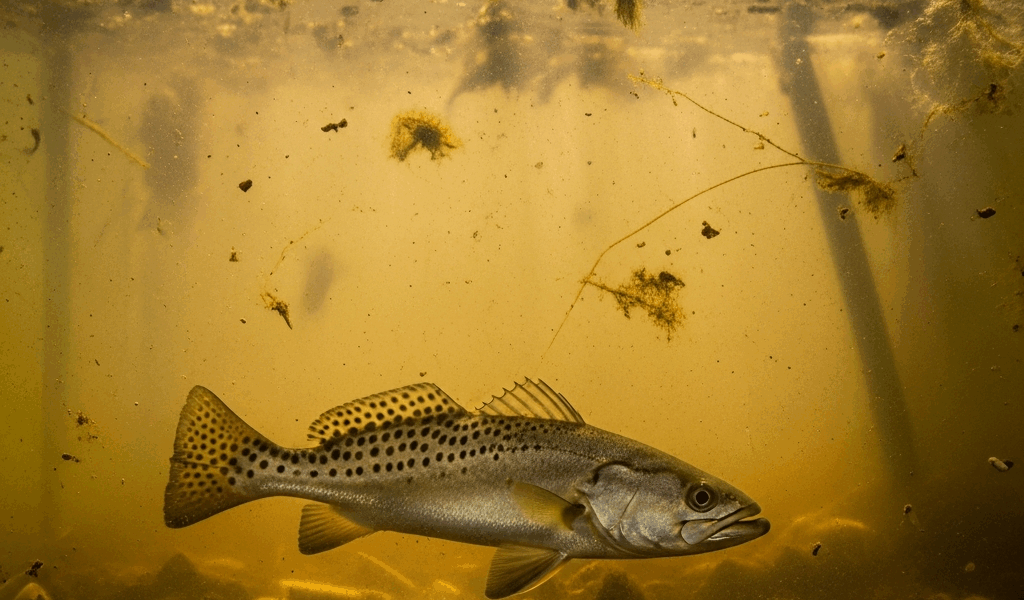
Speckled Trout Are Not Built for Livewells
Keeping speckled trout alive has gotten complicated with all the conflicting advice flying around. As someone who lost four solid 18-inchers in a single morning last June, I learned everything there is to know about why specks die in livewells. Today, I will share it all with you.
But what is a speckled trout’s real problem in a livewell? In essence, it’s biology. But it’s much more than that. Specks carry a thin, delicate slime coat — the kind that wipes off if you even look at it wrong. That coating does two things: fights off infection and keeps the fish’s osmotic balance from going haywire. Rough handling strips it. Thrashing against livewell walls strips it. Once it’s gone, bacteria move in fast, and the fish deteriorates from the inside out even when your water looks crystal clear.
Oxygen is the other half of the equation. Specks metabolize it faster than almost any other inshore species I’ve kept. A redfish will sit fat and happy in conditions that send a trout into immediate distress. Their gills are more delicate, too — any shift in water chemistry and they feel it first. This isn’t a gear problem. It’s not a you problem, either. It’s pure biology. Understanding that changes everything about how you run your livewell. So, without further ado, let’s dive in.
Water Temperature Is Killing Your Trout
Probably should have opened with this section, honestly. Temperature kills more speckled trout in livewells than anything else — and most anglers never even glance at a thermometer.
Speckled trout cannot handle warm water. Their upper tolerance sits around 72 to 74 degrees Fahrenheit. Cross that line and physiological stress kicks in. At 76 degrees, you’re borrowing time. At 80 degrees, just start the clock. That fish is already dying whether it looks like it or not.
Summer livewell temperatures spike faster than most people expect. I watched the water in my 25-gallon Lund livewell climb from 74 to 79 degrees in under two hours on a June afternoon — recirculation pump running the whole time. The aluminum hull absorbs direct sunlight. Warm air feeds back through the aeration system. The fish themselves throw off metabolic heat. By hour three or four, you’re sitting at 82 degrees if you haven’t actively intervened.
Three fixes, and all three matter. First, run your aerator continuously — not on the factory timer setting that most boats ship with. Moving water dissipates heat, not just oxygen. Second, shade the livewell. A white tarp or even a reflective cooler lid propped over the opening drops water temperature 3 to 5 degrees. Third, ice. A mesh bag holding about five pounds, dropped in at launch and refreshed mid-day, keeps the water between 68 and 72 degrees even in July. It doesn’t chill the entire volume — it creates a localized cooling effect. That’s enough.
Fall and winter flip the equation entirely. October through December, natural cooling does the work for you. Focus shifts to oxygen management and handling instead. That’s actually when most anglers keep specks alive the longest — at least if water temperatures stay cooperative.
Your Livewell Is Not Moving Enough Oxygen
That’s what makes this problem endearing to us anglers — we assume any running pump equals adequate aeration. It doesn’t. A standard 500 to 750 GPH livewell pump handles two redfish without breaking a sweat. Five speckled trout? Different story. Specks burn oxygen faster than redfish or drum, and most production boat livewells were designed with the latter in mind.
Stocking density is where anglers blow it most. Three to four healthy specks per 25-gallon livewell — that’s a realistic ceiling. I’m apparently someone who ignored that rule my first season, kept seven specks in the same 25-gallon well, and lost three of them despite a running pump and clean-looking water. The fish were simply outpacing the oxygen supply. Don’t make my mistake.
Watch the fish before they die. Listing to one side is a warning. Gulping at the surface is a warning — they’re reaching for air because the water isn’t delivering enough oxygen. Erratic, jerky swimming instead of smooth cruising is a warning. These signs appear before you lose the fish. If you catch them early, you still have time to act.
The fix is straightforward. Run the aerator full-time, not on a timer. Check your pump intake and discharge lines for clogs — a blocked intake starves the whole system. Use the recirculation option if your livewell has one. If your pump sounds weak or hesitates, replace it. A $150 upgrade beats losing $50 worth of fish. Some guys add a second aerator or step up to a higher-capacity unit entirely, but honestly, most problems trace back to two things: running the pump continuously and not overstocking. Handle those and you’re most of the way there.
Handling Mistakes That Stress Fish Before They Hit the Water
Frustrated by a slow bite one morning, I spent a full forty-five minutes fussing with a single speckled trout — slow hook removal, multiple photo angles, squeezing it for an estimated weight. The fish made it into the livewell. It died twelve hours later at the dock.
Handling time directly predicts whether a speck survives. The fight stresses them. The net stresses them. Hook removal stresses them. Photo sessions stress them. Every second in the air costs something. I’ve started using wet hands — or cotton gloves on cold mornings — because dry hands strip the slime coat in seconds. A 15-second hook removal with wet hands beats a 45-second one with dry fingers every time.
For photos, try the livewell camera trick. Shoot the fish inside the livewell while it’s still in water. The lighting won’t win any Instagram awards, but the fish swims away healthy. If you need a grip-and-grin shot, keep the fish half-submerged, horizontal, belly supported — and cap the air time at 20 seconds. That’s your limit.
Long fights hit specks harder than most other species. Their cardio recovery is genuinely slower. A five-minute battle on light tackle means a severely stressed fish before it ever sees your livewell. Sometimes the right call — and the honest one — is to ice that fish immediately instead of gambling on a livewell recovery.
How to Keep Speckled Trout Alive Until You Reach the Dock
Practical checklist for the boat:
- Check water temperature at launch. Above 74 degrees, add ice before the first cast.
- Run the aerator continuously from the moment you leave the ramp until the boat is loaded.
- Stock conservatively — three to four trout per 25-gallon livewell, no more.
- Handle fish with wet hands only. Remove hooks in under 20 seconds.
- Skip the extended photo session. Shoot fast or skip it entirely.
- Watch for listing or surface gulping. Either sign means you reduce stocking or push fresh water through faster.
- Refresh ice as needed on all-day trips — don’t assume the morning bag lasts.
- Consider immediate icing after a brutal fight or if livewell conditions deteriorate mid-day.
Your speckled trout don’t have to die in the livewell. They’re just more demanding than the species sitting next to them in the water. Meet those demands — temperature, oxygen, handling time — and you’ll pull healthy fish off the boat instead of watching them go belly-up on a stringer before you ever reach the dock.

Stay in the loop
Get the latest saltwaterspots.com updates delivered to your inbox.