How to Catch Speckled Trout From Shore — Tides, Baits, and Technique
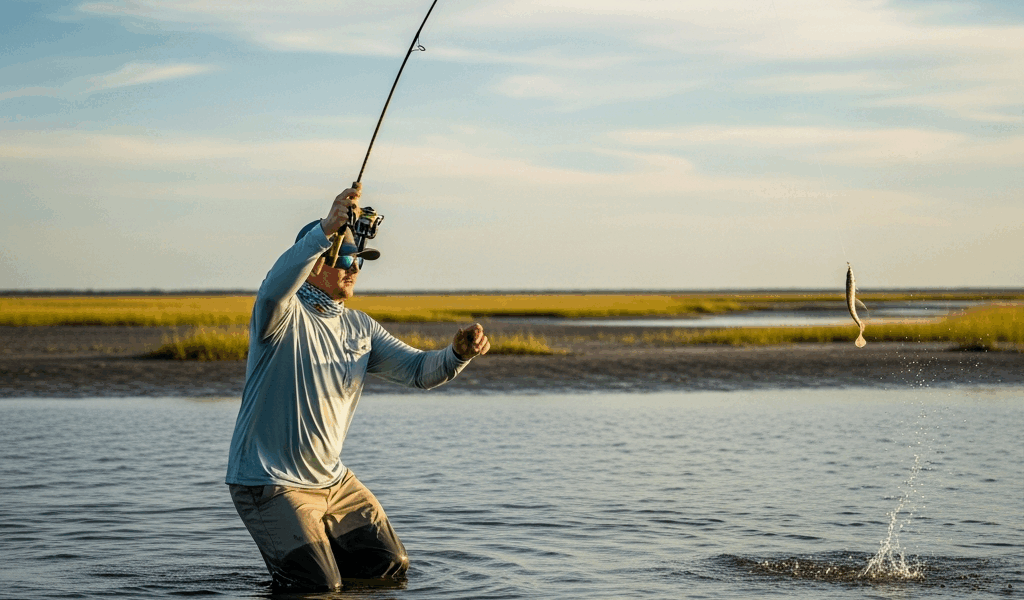
Shore fishing for speckled trout has gotten complicated with all the boat envy flying around. As someone who spent three embarrassing years convinced I needed a skiff with a push pole just to be taken seriously, I learned everything there is to know about catching specks from dry land — or close to it. The actual turning point was watching some guy in rubber boots wade a grass flat outside of Rockport, Texas, pulling fish after fish while I sat in my truck eating a gas station kolache. That was it. That was the education. Shore fishing and wade fishing for speckled trout isn’t settling. For certain situations — early fall mornings, incoming tides on shallow flats, those long summer evenings — it’s genuinely the best approach. You’re quiet. Low-profile. You can position yourself exactly where the fish are without an engine blowing them off the flat.
Why Speckled Trout Are the Best Shore Target in Saltwater
But what is a speckled trout, really? In essence, it’s a shallow-water ambush predator — officially spotted seatrout, Cynoscion nebulosus — that spends a significant chunk of its life in water barely deep enough to cover its back. But it’s much more than that. These fish work grass flat edges, oyster bars, and tidal creek mouths. Structure and current hold them. Depth is almost incidental, as long as there’s enough water to keep them covered.
Their feeding style is what makes them so catchable from the bank. They don’t chase bait across open water the way Spanish mackerel do — tearing around burning energy. Speckled trout sit at edges. The drop-off where grass meets sand. The shadow line along an oyster bar. They wait for current to push shrimp and mullet into range, then they eat. That’s a style of feeding that shore fishing was practically designed for. You don’t need to cover miles. Find the right edge, put your bait in the right place, and the fish are already there waiting on you.
Temperature sensitivity is another thing. Below 55°F, speckled trout go sluggish — dramatically so. Push above 90°F on a shallow flat and they’re gone, moved to deeper, cooler water. Shore anglers need to internalize this because it determines where fish will actually be month to month. A flat that was loaded in October can be completely dead in January. Same flat, totally different situation.
One more thing worth knowing: speckled trout are loud feeders. When they’re actively working a flat, you’ll hear it — quick, slapping strikes as they crash bait near the surface. That’s real-time information shore anglers can actually use. You’re standing in the water, not looking down at a sonar screen from above. That’s what makes speckled trout endearing to us shore anglers.
Best Tides and Times for Speckled Trout From Shore
Probably should have opened with this section, honestly. No technique in the world covers for fishing the wrong tide at the wrong hour. Tide is the engine behind speckled trout feeding. Without moving water, there’s no current pushing bait, no reason for fish to sit on edges, no real feeding happening. A slack tide on a summer afternoon is — and I mean this — close to a waste of time.
Incoming Tide — The Most Reliable Window
Incoming tide is the single most productive window for shore-based trout fishing. As water rises, it floods grass flats that were barely covered — or fully exposed — at low tide. Shrimp, crabs, small baitfish all move onto those flats with the rising water, and the trout follow. You’ll find fish in spots that look too shallow to hold anything. Shin-deep, sometimes. Eighteen inches of water. They’re there.
Get to your flat 45 minutes before the tide turns incoming. That gives you time to position without pressure and puts you in the water before the first hour of push — which is consistently where the action is. Tide charts are free. I use Tides.net and cross-reference with the NOAA tide predictor for my specific inlet. Takes three minutes, maybe less.
Season-by-Season Breakdown
Summer fishing from shore is an early-morning or late-evening game. Full stop. Midday in July, a shallow flat can hit 92°F, and the fish are already gone — pushed deep. Be on the water before sunrise. Work the first two hours of daylight. Come back around 7 PM if you want a second shot. Topwater works well in this low-light window — a Heddon Super Spook Jr. in bone white or chrome is hard to beat, and you’ll feel the strike through the rod before you even see it.
Fall is the season. September through November, dropping water temps, speckled trout stacked on shallow flats — that’s as good as shore fishing gets in saltwater. As surface temperatures slide from summer peaks into the mid-70s and eventually the 60s, trout become aggressive feeders putting on weight before winter. They concentrate on grass flat edges and creek mouths. The fish run bigger on average, the bites are harder, and you don’t need to wake up at 4 AM. A 9 o’clock incoming tide in October is genuinely productive fishing.
Winter from shore is location-specific. Cold-stunned fish, water below 55°F — those conditions push trout into deeper holes near shore structure. Boat docks with depth underneath, rock jetties, the deep bend of a tidal creek. You’re not wading a flat in January across most of the Gulf Coast. Look for hard structure with bank access and fish slow, near bottom. Soft plastic on a light jig head, dead-drifted in the current seam.
Spring is the transition. Water warms, fish start moving back toward flats. April and May can be excellent, though fish are more scattered than in fall. Work creek mouths and the first grass flat edges adjacent to deeper water — fish stage there before committing to the shallows.
Bait and Rigging for Shore-Based Trout Fishing
Frustrated by years of missed strikes I kept blaming on fish behavior, I finally just watched the guy at the bait shop in Port O’Connor rig his popping cork setups before one trip — start to finish, asking questions the whole time. Five minutes. That was a five-minute conversation that fixed problems I’d been carrying around for two seasons. Rigging matters more than most people want to admit.
The Popping Cork and Live Shrimp Setup
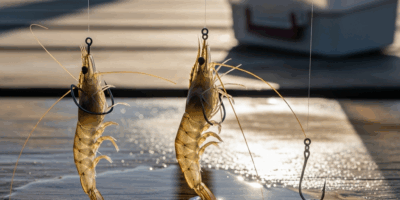
This is the foundational rig. A popping cork — the concave-face kind that displaces water and makes noise — suspends live shrimp at a precise depth and creates surface disturbance that pulls fish in. The noise mimics feeding activity. Trout come to investigate and find the shrimp hanging underneath.
Here’s how it goes: 20 lb fluorocarbon leader material — not mono. Fluorocarbon sinks, which helps your shrimp hang naturally, and it’s less visible in clear water. Cut an 18-inch leader. Tie a 1/0 circle hook on one end with a Palomar knot. Attach the other end to the snap swivel under the cork. Set the cork so the shrimp rides 18 inches down. In water under two feet, drop it to 12.
Hook the live shrimp under the horn — the pointed rostrum on the head — rather than through the tail. Through the horn, the shrimp stays lively and swims naturally. Through the tail, it spins. Trout eat spinning shrimp, sure, but the presentation is noticeably worse. Use the tail as a fallback when your bait is stressed and soft.
Retrieve cadence: pop twice, pause three to four seconds, pop once, longer pause. That irregular rhythm beats a steady pop-pop-pop every single time. Strikes happen on the pause — not during the pop. Resist the urge to keep working it. The pause is actually the presentation.
Don’t make my mistake: with a circle hook, you cannot set it with a hard upward snap. That’s a J-hook reflex and it pulls the bait straight out of the fish’s mouth. Reel down, come tight with a steady sweeping motion, and let the circle hook rotate and seat itself in the corner of the jaw. I ripped a fish well over 20 inches my first time using circle hooks because I yanked on instinct. Once. Never again.
This article includes affiliate links. We may earn a commission at no extra cost to you.
The DOA Shrimp — Best Artificial Alternative
DOA Shrimp might be the best artificial option, as speckled trout fishing requires something that actually behaves like a shrimp. That is because these fish are keyed in on shrimp behavior — the way it moves, the way it sinks — more than almost any other cue. The 3-inch model in root beer/gold glitter or new penny weighs enough to cast on a medium-light spinning rod and has built-in scent that holds up through multiple fish. Rig it weedless on a 3/0 wide-gap hook if you’re working heavy grass. Fish it under a popping cork like live shrimp, or work it on a slow twitching retrieve along a flat edge just off the bottom. The DOA isn’t a guess — it’s a production bait with decades of documented fish behind it.
Reading the Water — Where to Cast From Shore
The best shore anglers I’ve fished around spend real time looking before they ever make a cast. Five minutes scanning the flat before you wade in saves you from walking straight through the fish and blowing the whole spot. This is learnable. It just requires slowing down when your instinct is to hurry up and start fishing.
Grass Flat Edges
The most reliable shore target — consistently, across seasons — is the edge where a grass flat meets bare sand or a depth change. Stand at the flat and find where the grass stops. That transition line is where trout stage. Current runs along it. Bait piles up there. Cast to the edge, not into the middle of the grass. If you’re wading, position yourself a comfortable cast-length back from the edge and work parallel to it, covering water methodically as you go.
Oyster Bar Drop-Offs
Oyster bars are fish magnets — and they’re tactile. You can feel the shell crunching underfoot when you wade onto one. The productive zone isn’t on top of the bar, though. It’s on the drop-off on the downcurrent side, where current sweeps around the structure, creates a seam, and dumps bait into the slightly deeper water just off the edge. That seam is where trout hold. Cast across the bar, work your popping cork into the drop-off, and let the current drag it along the edge. Passive presentation, but it covers the zone well.
Creek Mouths With Moving Water
Any tidal creek mouth with current pushing through it is worth fishing on both tides. Incoming — fish stack at the mouth waiting for bait to sweep in from the bay. Outgoing — bait funnels out of the creek and fish position just outside the mouth in the stronger current seam. A creek mouth with a sand bar or oyster shell on one side is about as close to a guarantee as shore fishing offers.
Visual Cues Worth Learning
Watch for nervous water — a subtle rippling on a calm surface where baitfish are being pushed by something underneath. It’s not a splash. It’s more like the surface is quietly breathing. When you see it, cast beyond it and work your bait back through the zone. Birds are a secondary signal. Laughing gulls dipping to the surface means bait has been pushed up — trout will be underneath. Cast to the outside edge of the bird activity, not into the center of it. Fish on the perimeter are less spooked and more likely to eat.
Rip lines — where fast current meets slower water — show up as a distinct color change or a difference in surface texture. They hold bait and they hold trout. These form off points of land, at the mouths of passes, along the edges of spoil islands. All shore-accessible in most Gulf Coast estuaries. None of them require a boat.
While you won’t need a full offshore setup, you will need a handful of specific things: a tide chart, a popping cork, 20 lb fluorocarbon, and a flat worth wading. First, you should find that flat — at least if you want to stop fishing water that doesn’t hold fish. That’s the whole formula. Everything else is just details.

Stay in the loop
Get the latest saltwaterspots.com updates delivered to your inbox.