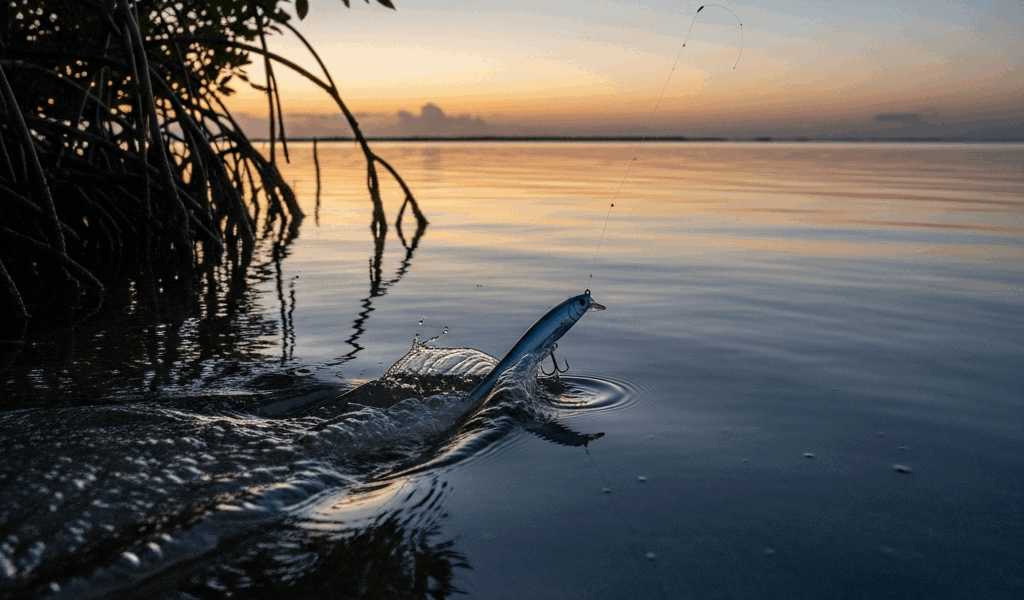
The Low-Light Window and Why It Changes Everything
Redfish topwater fishing has gotten complicated with all the conflicting advice flying around. But after three seasons grinding the Laguna Madre flats, I learned everything there is to know about why the light window matters more than almost any other variable. Today, I will share it all with you.
So what actually happens during low light? In essence, visibility from above collapses. But it’s much more than that. During the first 90 minutes after sunrise — and the final 60 before dark — the sun sits so low that a redfish looking upward through the water column sees silhouettes instead of details. A topwater lure that screams “fake” under noon sun reads as a fleeing baitfish when the sky goes orange or gray. That’s the whole game right there.
I spent those three seasons on the Laguna blaming myself for slow mid-day bites. Turned out the fish weren’t being difficult. They were being smart. Full sun pushes baitfish deeper into grass and structure — same light that makes reds aggressive also makes baitfish cautious. Dawn and dusk flip that. Baitfish push shallow, move toward the surface, feel safer up top. Your topwater lure gets mistaken for genuine forage movement rather than a chunk of rubber being dragged through their living room.
Light penetration also changes how reds orient themselves physically. Full sun? They hold deeper, hug cover, hunt by sight. Low light? They push confidently into the shallows. Their lateral line picks up vibrations from your topwater work before their eyes even find the lure. Reduced visual scrutiny plus heightened lateral line sensitivity — that combination is why topwater gets absolutely hammered during these windows. That’s what makes the low-light bite endearing to us redfish anglers.
What Redfish Are Actually Doing When You Arrive
Probably should have opened with this section, honestly. Before you cast anything, you need to recognize staging behavior.
Redfish don’t just appear everywhere at dawn. They hold in specific spots waiting for conditions to flip into feed mode. Shallow grass edges are the obvious play — reds stage just outside where depth drops from roughly 18 inches down to 3 feet. That’s not random. It’s an escape route. Threatened? They slide into deeper water instantly. Low-light window opens? They push back shallow knowing their visibility disadvantage cuts both directions. Oyster bars work the same way. A red holding on the back side of a bar during bright conditions will move to the bar’s leading edge — the side facing incoming water flow — as light fades.
Points where shallow flats meet deeper channels are gold. I learned this the hard way after wasting an entire week casting to open water. A friend finally asked where I’d seen nervous water. That was the question I didn’t know I needed. Nervous water looks like a thousand tiny disturbances — baitfish flickering near the surface, wakes that don’t match wind direction. See that, and reds are already feeding or about to. Cast near it. Not away from it. Don’t make my mistake.
Read the water before that first cast. Cruising reds leave wakes. Tailing reds show their fins above the surface. Fish in feed mode create nervous water. None of it guarantees a hookup, but it confirms you’re not casting to empty real estate. That confidence shift changes everything about your approach — the angles you work, the pauses you take, how patient you stay.
The Retrieve That Triggers Strikes at Dawn and Dusk
Low-light topwater success hinges entirely on retrieve cadence. Most anglers fish topwater the same way regardless of conditions. That’s the mistake.
Bright daylight calls for erratic, aggressive presentations — rapid pops, quick walks, constant motion. Low light? Slow down fundamentally. Your retrieve should feel almost methodical. Walk-the-dog with deliberate pauses between side-to-side twitches. Give the lure time to settle. Let it actually sit there. That pause is when strikes happen — reds are locating the disturbance source through their lateral line, not chasing visual movement the way they do mid-day.
While you won’t need a whole tackle shop, you will need a handful of reliable lures worth testing. A She Dog or Heddon Super Spook Jr. both excel during low-light periods — they walk cleanly with minimal rod effort. You’re not muscling the lure. You’re guiding it. The She Dog runs around $7 to $9 retail. The Super Spook Jr. comes in slightly cheaper. Both are worth running side-by-side to see which one your local fish prefer on a given morning.
I’m apparently a compulsive twitcher, and the She Dog works for me while constant motion never produces during low light. Kill the lure entirely between retrieves. Three to five seconds of dead stillness. Movement triggers the hunt. Stillness triggers the bite. I wasted entire seasons twitching constantly before the dead pause started doing the actual work for me.
Why the Bite Dies When the Sun Gets High
You’ve caught two reds in the first 45 minutes after sunrise. You feel unstoppable. By 8:30 AM — nothing. Same water. Same structure. The reds didn’t leave. The light changed on them.
As the sun climbs, light angle steepens. Reds can now see upward more clearly, which means they see your lure for what it actually is. An artificial. Simultaneously, water temperature creeps up one to two degrees. Warm water holds less oxygen. Baitfish drop to depth seeking cooler, oxygenated layers. Your topwater lure is now fishing empty water above where the forage actually lives. That’s a losing proposition no matter how perfectly you work it.
When the morning bite dies, don’t abandon the area. Switch presentations — a soft plastic under a popping cork, or a slow-sinking stick bait worked tight along the grass edge. The reds are still there. They’ve moved down roughly six feet and changed what they’ll eat. Find shade and structure too. Mangrove shadows, boat docks, deeper pockets within the flat. Reds compress into these zones during bright hours. Your topwater magic returns in that last hour before dark. So, without further ado, let’s talk about stacking that evening window properly.
Tides Overlap With Light — How to Stack Both
An outgoing tide during the low-light window creates amplified aggression. Baitfish concentrate on edges where moving water pushes them. Reds stage predictably to intercept that flow. The feeding window extends longer than usual — morning low light plus an outgoing tide can hold a topwater bite for 90 minutes instead of the typical 60.
Here’s the simple framework: outgoing tide pairs better with early morning light. Incoming tide pairs better with evening light. That’s not law, but it’s the overlay that stacks probability in your favor. Check tide tables before you launch, then plan your window around which tide direction is moving. Fish the right light on top of the right tide movement, and you’ll stop wondering why some days hold fish for hours while others go quiet inside 45 minutes. That’s what makes tide-stacking endearing to us flats anglers — it turns chaotic days into predictable ones.

Stay in the loop
Get the latest saltwaterspots.com updates delivered to your inbox.