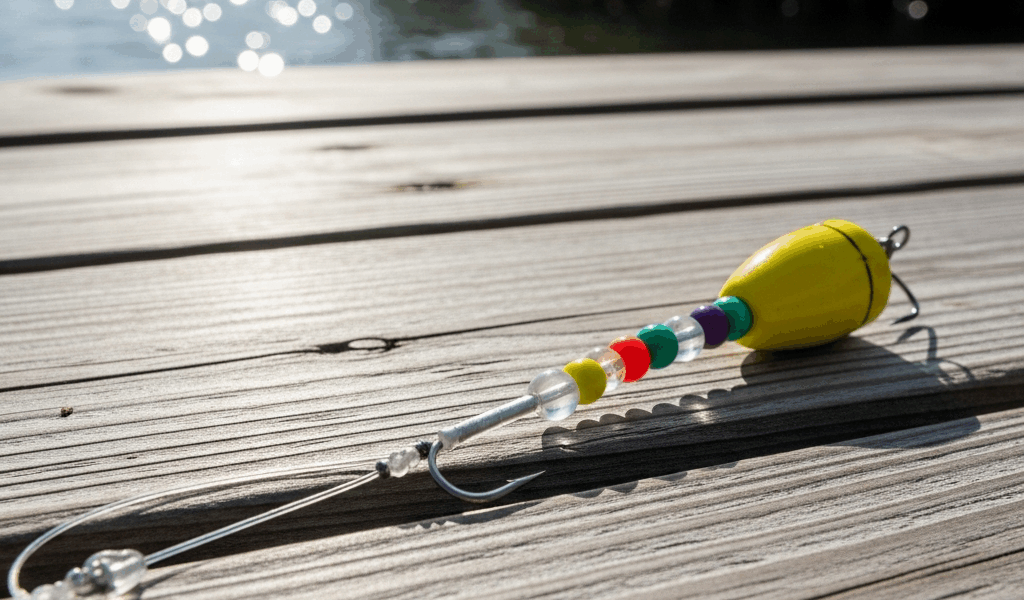
Why Your Popping Cork Rig Is Not Catching Fish
Popping cork fishing has gotten complicated with all the conflicting advice flying around. YouTube tutorials show guys hauling in redfish back-to-back, and meanwhile you’re standing knee-deep in a grass flat wondering if your rig is even in the water correctly. As someone who spent an embarrassing number of mornings debugging this exact problem — including one particularly humbling session where I switched to a free-lined shrimp after an hour and immediately landed three reds — I learned everything there is to know about why popping cork rigs fail. Today, I will share it all with you.
Most articles cover how to build a cork rig or explain the general concept. Fine. But if you’re here, you’ve already got one in the water and it’s not working. What you actually need is a diagnostic process — something that isolates the real mistake instead of throwing theory at you.
I’ve narrowed it down to five specific issues, ranked by how often each one genuinely kills a fishing session. Work through them in order. You’ll probably find the answer before you hit the bottom of the list.
Your Leader Length Is Probably Wrong for the Depth
This is the number-one culprit. I see it constantly, and I used to do it myself.
Most anglers default to an 18-inch leader without a second thought. Eighteen inches feels like a safe middle-ground — reasonable, non-committal, hard to argue with. But it only works in very specific conditions, and it fails badly everywhere else. In water deeper than 3 feet, that 18-inch leader suspends your bait way too high. The fish are feeding near the bottom or just above the grass line. Your shrimp is doing its thing six feet above them.
Flip the scenario. Shallow grass flat with cordgrass sitting 18 inches off the mud — that same leader buries your bait on the first cast. The shrimp gets tangled, the action stops, and you’re picking vegetation off your hook for ten minutes. Don’t make my mistake.
Here’s the actual rule: your leader should suspend the bait 6 to 12 inches above the bottom or just above the top of the grass, whichever is higher.
Checking depth doesn’t require any special gear. Wade out to where you want to fish. Hold your rod up with the cork at eye level. Lower the tip straight down until the bait just ticks the bottom — lightly, barely. That’s your working depth. Now measure back to where the bead sits. Should be 6 to 12 inches. If it’s reading 24 inches, your leader is too long. Two inches? Too short.
Fix is simple. Retie the bead. Takes 90 seconds, no new materials. Slide it up the line to shorten the working depth, down to lengthen it. Test again with the same rod-tip method before you start fishing again.
The Bead Is Clicking But Fish Are Not Responding
Probably should have opened with this section, honestly. If your cork is actually popping — if you’re getting surface disturbance and noise — but strikes never follow, the problem is almost always cadence.
Beginners pop too fast. There’s something instinctively satisfying about aggressive surface action, but speed doesn’t mean attraction. A fast, frantic cadence produces noise without meaning. Fish see something moving chaotically and either ignore it or spook — and in clear water, spooking is the more likely outcome.
Start slow. One pop every two to three seconds, then a pause. Pop. Wait. Wait again. Pop. In clear water targeting speckled trout, this deliberate rhythm consistently outperforms rapid-fire noise. The pause matters — it lets each pop register as a distinct sound instead of blending into ambient surface chatter.
Conditions change everything. Mullet schools churning nearby, active redfish in stained water — speed up slightly, maybe one pop per second. Post-cold front, midday heat in August — slow down to one pop every three to five seconds. The fish are lethargic. Give them time to locate the source and commit.
Wind factors in too. Eight to ten mph chop? Work a bit faster. Dead calm? Slow down significantly — silence amplifies every sound, and aggressive popping in glassy conditions actually repels fish instead of drawing them in.
Your Hook Size Is Killing the Bait Presentation
This one stings because the fix costs about forty cents.
Oversized hooks on live shrimp are a silent presentation killer. A heavy 3/0 or 4/0 hook weighs the shrimp down — prevents it from swimming naturally, makes the whole bait sluggish and unresponsive. It hangs wrong. Fish pick up on it. They don’t commit.
For live shrimp under a cork, use light-wire hooks in the 1/0 to 2/0 range. Kahle-style or circle hooks in those sizes let the shrimp swim with minimal restriction. The light wire doesn’t fatigue the bait, so it stays lively longer — and a lively bait is what triggers the strike, not the rig itself. I’m apparently a Kahle hook person, and Owner brand works for me while other styles never seem to hook up as clean. But a basic light-wire 1/0 from any decent tackle shop will get you there.
Running cut bait or soft plastics under the cork? More flexibility there. A 2/0 to 3/0 works fine because the bait isn’t swimming anyway. Live shrimp demand restraint on hook weight. That’s the difference.
The Cork Is Set at the Wrong Depth for Where Fish Are Holding
But what is cork depth, exactly? In essence, it’s the total distance from the cork to the bait — not the leader, but the whole rig. But it’s much more than that. It’s the difference between your shrimp swimming where redfish are actively feeding and your shrimp swimming through empty water column three feet above them.
Three scenarios come up most often. Over a shallow grass flat with spartina rising 18 inches off the bottom, set the cork 12 to 18 inches from the bait — shrimp dances just above the grass where fish cruise. Over a channel edge dropping to 4 or 5 feet, set the cork 24 to 36 inches so the bait swims in mid-column near structure. Over shell reef or oyster bed, start around 24 inches and adjust after the first few casts.
Most adjustable corks use a peg system. Slides along the line, changes depth in seconds without retying. If five minutes pass with no strikes, pull the cork slightly higher or lower and work the zone again. The difference between 20 inches and 28 inches is sometimes the difference between a fish and nothing. That’s what makes fine-tuning the depth endearing to us cork anglers — tiny adjustments actually matter.
You Are Fishing It in the Wrong Conditions Entirely
Popping corks are not a universal tool, despite what the marketing suggests.
The cork thrives in low to moderate wind — roughly 5 to 12 mph — with enough chop to mask the line and add natural movement to the surface. In glassy, dead-calm conditions, the cork is too loud and too visible. Fish see the rig clearly, and the noise reads as unnatural. In heavy wind, the cork drifts faster than you can work a zone, and any hope of consistent cadence disappears.
Water clarity matters too. Stained to slightly murky water — visibility in the 18 to 30-inch range — is the cork’s home environment. The noise and surface disturbance work as an attractor because the fish can’t see the rig itself. Crystal-clear water? Use it sparingly or not at all. Black, tannic water, you can use it, but you lose the visual component entirely.
Tide stage is simple: fish the cork when water is moving. Slack tide and falling water kill the bite. Rising tide on a full or new moon is peak cork time. That was the first thing an old guide told me before I understood any of the rest of it. Took me two seasons to actually listen.
If conditions are wrong — dead calm and crystal clear, full-on wind and rain, or slack tide during a cold front — stop forcing it. Switch to a free-lined shrimp under a split shot or a soft plastic on a light jighead in the 1/8-oz range. Come back to the cork when conditions improve. So, without further ado, let’s be honest about the math: one hour with the right tool beats three hours with the wrong one every single time.

Stay in the loop
Get the latest saltwaterspots.com updates delivered to your inbox.