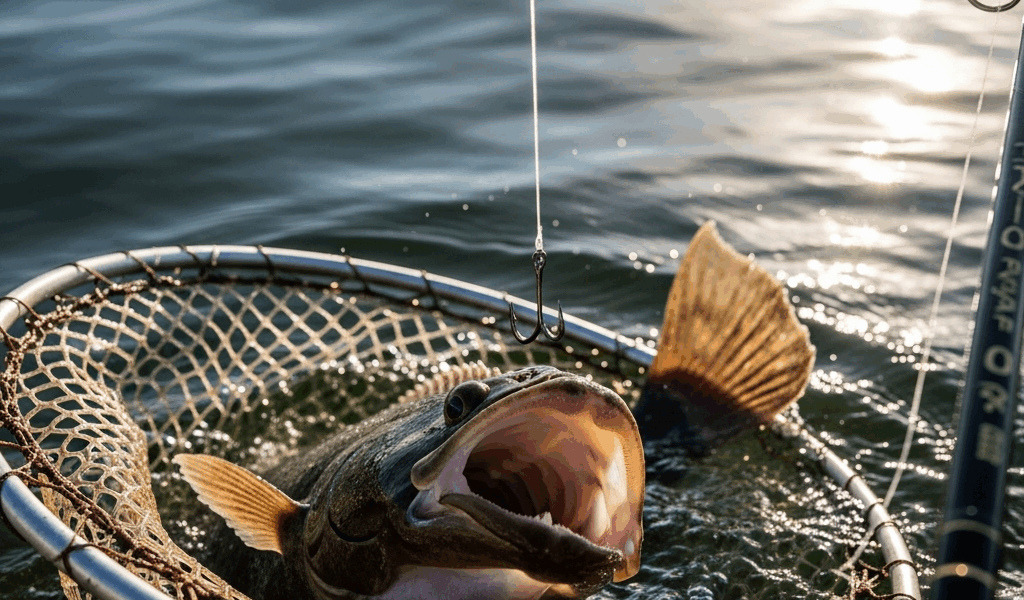
Flounder Drop Off More Than Any Other Inshore Fish
Flounder fishing has gotten complicated with all the conflicting advice flying around. And honestly, most of it misses the actual problem — which isn’t your technique, your rod, or your line. It’s the fish itself.
Flounder are built wrong for the way we fish them. Not wrong as in poorly designed — they’re apex ambush predators. Wrong for us. I grew up fishing the Carolina flats and lost more flounder at the boat than I care to admit before I finally understood why. Today, I’ll share everything I learned so you don’t have to repeat the same frustrating pattern.
But what is the core problem here? In essence, it’s anatomy. But it’s much more than that.
Flounder have soft mouths. Their jaw structure lacks the reinforced bone density you get in redfish or snapper. A flounder doesn’t commit with a violent strike like a tarpon. It inhales. Pauses. Tests. Then either swallows or ejects. That millisecond window is where most anglers lose fish before they even realize they’re hooked.
Their body orientation makes it worse. Flounder hunt flat and sideways — approaching bait from below and to the side — which means your hook often catches soft tissue instead of jaw bone. The roof of the mouth. The gill area. Those tissues tear under pressure. Light tension pulls the hook clean through. Every single time.
This is not a skill issue. It’s a fish anatomy issue. Once you understand the mechanism, you can engineer around it. So, without further ado, let’s dive in.
You Are Setting the Hook Too Fast or Too Slow
Probably should have opened with this section, honestly. Hook timing kills more flounder than anything else — more than bad gear, more than poor presentation, more than anything.
The flounder strike has a distinct rhythm. You feel the initial tap — bait getting investigated. Then nothing. That nothing lasts maybe two seconds. Then the weight transfer. The fish is moving away with the bait. That is your hookset moment. Not the first tap. Not ten seconds later. The weight transfer.
On live bait — mullet, menhaden, finger mullet running around $4–$6 a dozen at most coastal bait shops — count it out: tap, pause (one Mississippi, two Mississippi), then set with a crisp upward motion. Not a jerk. A set. There’s a difference. You’re driving the point through the upper jaw, not ripping the rod out of its socket.
Soft plastics are a different animal. Paddle-tail shads rigged on jigheads don’t produce a dramatic initial strike. You feel weight. Heaviness. That’s the fish. Set immediately when you feel that firmness — the flounder already knows something is off. A half-second delay here costs you more fish than any other presentation variable I’ve ever encountered.
Too fast and you snag maybe one gill arch and nothing structural. Too slow and the flounder spits the bait before your hook finds purchase. Two seconds on live bait. Half a second on plastics. Train your hands to feel the difference. It takes time, but it’s the whole game.
Your Hook Is Wrong for the Way Flounder Feed
Frustrated by losing fish after fish at the boat during a trip near Murrells Inlet — eight dropped fish in one afternoon — I finally swapped out my standard wide-gap J-hooks for Kahle-style hooks using ones I grabbed from a dusty bin at a local tackle shop for about $3.49 for a pack of six. My drop-off rate fell by roughly 40 percent that same week. Not exaggerating. A legitimate game-changer.
Wide-gap hooks are built for bigger mouths and violent strikes — bass fishing logic, essentially. Flounder don’t operate that way. They need a hook that penetrates soft tissue and holds fine bone structure. Kahle hooks — with that offset shank and inward-turned point — were engineered for exactly this kind of saltwater bottom feeder scenario. That’s what makes Kahle-style hardware endearing to us flounder anglers.
For live bait rigs, use a 2/0 or 3/0 Kahle or circle hook. Size matters more than most anglers realize. Too big and the point doesn’t reach the jaw when the bait is inside the fish’s mouth. Too small and penetration becomes an issue, especially if the hook has dulled. Circle hooks are underrated here because they self-set when the fish turns — no perfect timing required. Just steady pressure.
For soft plastics — 4-inch to 6-inch paddle tails, specifically — use a 1/8-ounce to 1/4-ounce jighead with a sharp 1/0 or 2/0 hook. The weight-to-hook ratio matters because it affects bite sensitivity directly. Too heavy and you won’t feel the initial mouth contact. Too light and you won’t get proper penetration through that thick upper jaw.
Hook sharpness is non-negotiable. A dull hook bounces off a flounder’s jaw every time — I’ve tested this more than I wanted to. Drag your hook point lightly across your thumbnail. It should catch and stick. If it slides, sharpen it with a ceramic rod or replace it. I’m apparently unusually diligent about this, and replacing hooks every third outing works for me while fishing dull ones never does. Don’t make my mistake.
Drag and Rod Angle Are Losing You Fish at the Net
The last five feet of the fight is where you lose more flounder than the entire battle before it. That’s not hyperbole — it’s where the anatomy problem hits hardest.
Drag tension is the usual culprit. Set your drag to slip at roughly 25 percent of your line’s rated pound test. Running 15-pound fluorocarbon? Set it to slip at around 4 pounds of pressure. Most anglers crank drag tight during boat-side work, thinking more tension means better control. The opposite is true. Tight drag on light leaders pulls through tissue. Loose drag lets the fish tire without tearing.
Rod angle matters more at the net than anywhere else in the fight — and this is the part nobody talks about. Keep your rod tip at 45 degrees throughout the retrieve. When the fish is boat-side, a lot of anglers point straight up — a vertical fighting angle. This creates slack line the moment you lower the rod to net. Slack line equals a dropped hook. Maintain 45 degrees all the way to the net. Steady pressure. Consistent tension.
Don’t rush the net. Seriously. Let the flounder tire itself in the last 10 feet. Approach it head-on if possible, guide it smoothly toward the opening, scoop from the head — not the tail. A spooked flounder in close quarters thrashes and shakes the hook free. Patience here isn’t wasted time. It’s prevention. That was probably the last lesson I fully absorbed, and it took an embarrassing number of lost fish to get there.
Run Through This Quick Checklist Before Your Next Drop
- Hook sharpness: Drag your hook point across a thumbnail. It should stick, not slide. Replace or sharpen anything that doesn’t.
- Hook style: Kahle or circle, 2/0–3/0 for live bait; 1/0–2/0 for soft plastics on jigheads.
- Leader pound test: 20–30 pound fluorocarbon minimum. Anything lighter tears under net pressure — especially in the final few feet.
- Drag setting: Set to slip at 25 percent of your line’s rating. Test it with your hand before you cast, not after you’re already fighting a fish.
- Hookset timing: Wait for the weight transfer on live bait — that two-second pause matters. Set immediately on soft plastics the moment you feel firmness.
- Rod angle: Maintain 45 degrees through the entire fight, especially at the boat. Vertical angles kill good flounder at the worst possible moment.
Screenshot this. Bring it out with you. Flounder will find ways to humble you regardless — but coming unbuttoned at the net shouldn’t be one of them.

Stay in the loop
Get the latest saltwaterspots.com updates delivered to your inbox.