The Moment Everything Goes Wrong
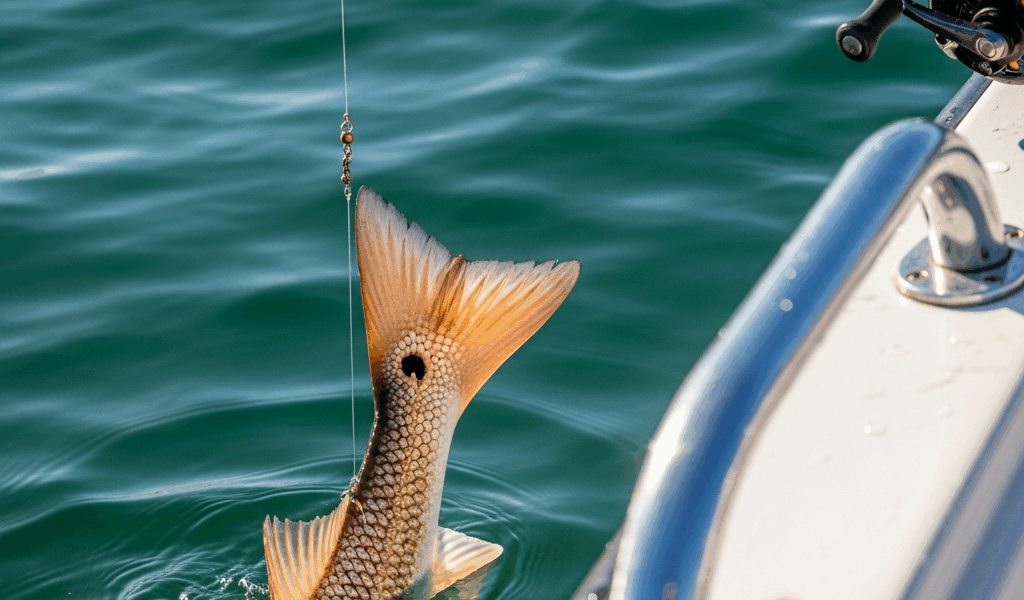
Redfish fishing has gotten complicated with all the gear advice and technique noise flying around. But the real problem most anglers face isn’t at the cast or the hookset — it’s in those final ten feet. The fish is right there. Your guide is reaching for the net. And then the rod goes slack.
Gone. Just like that.
As someone who’s spent fifteen-plus years sight-fishing the shallow bays of Louisiana and Texas, I learned everything there is to know about losing redfish at the boat. Not in fifty yards of open water — that’s manageable. I mean the losses that happen when you can almost touch the fish. When you’ve already started celebrating. Those are the ones that haunt you on the drive home.
Today, I will share it all with you.
Three things are costing you those fish. Rod angle. Drag pressure. Hook choice. That’s it. Fix those, and the redfish that are currently swimming away laughing start coming to the net instead.
Your Rod Angle Is Working Against You
Probably should have opened with this section, honestly.
When a redfish gets inside twenty feet, something weird happens to your body — the rod tip drops. Not on purpose. You’re exhausted. You’ve had that rod up for three, maybe four minutes. Gravity does what gravity does. The tip comes down during the micro-pauses between head shakes, and you don’t even notice it until the fish is gone.
That dropped tip creates slack. Even eighteen inches of slack is enough. Redfish aren’t stupid fighters — they feel that lost tension instantly and go sideways, rolling hard, twisting their whole body. A hook that was buried clean in the corner of the mouth suddenly has room to rotate. The barb loses contact. One more head shake and it falls out completely.
The fix is uncomfortable, which is probably why people resist it. Keep the rod tip high — not straight up at twelve o’clock, that’s awkward and leaves you nowhere to go when the fish surges. Aim for ten to eleven o’clock. Elbows tucked in. Steady, unbroken pressure from the moment that fish hits the fifteen-foot mark.
Redfish near the boat don’t make long runs. Those are already behind you. What they do instead is panic — short, violent bursts that come with zero warning. An elevated rod tip gives you the mechanical cushion to absorb those without dropping tension. You’re not muscling the fish. You’re managing geometry. There’s a difference.
Keep the rod high. Keep the pressure even. Watch what happens.
Drag Too Tight at Close Range Is a Real Problem
Most anglers set their drag on the dock before sunrise and never touch it again. That works fine in open water. At the boat, it’s a disaster waiting to happen.
But what is drag tension actually doing to your hook? In essence, it’s transferring force directly through the line to wherever that hook point is sitting. But it’s much more than that — it determines whether the hook holds or rotates free.
Redfish jaw tissue isn’t solid bone. It’s a mix of cartilage, muscle, and softer material depending on where the hook landed. When the drag is cranked tight and the fish makes a sudden close-range surge — and it will, every single time — that load doesn’t break the line. It yanks the hook sideways or backward instead. If the point is sitting in softer lip tissue, that pressure pops it loose. Done. Fish gone.
I’m apparently a “back it off near the boat” guy, and that habit works for me while keeping drag locked never does. Once a redfish is inside twenty feet, I ease the drag slightly. Not completely loose — still firm enough that casual head shakes don’t peel line. But one sudden surge should pull twelve to eighteen inches. That easing of pressure keeps the hook from rotating out of softer tissue.
Don’t make my mistake of waiting too long to adjust. The window is tight — fifteen feet and closer, that’s when it matters.
If you’re running a conventional setup like an Avet LX or a Daiwa Sealine SG27, the physical star drag gives you tactile feedback. Spinning reel guys using a Shimano Stella SW 5000 or a Penn Spinfisher VI have smoother drag curves built in, which helps — but you still need to consciously ease off. The principle is identical regardless of reel type. Close range, ease off. Let the fish pull line rather than rotate the hook.
Hook Size, Style, and Where It Actually Sat in the Mouth
Not all hooks land in the same place. That’s what makes hook selection endearing to us anglers who’ve spent real time obsessing over it. A 4/0 circle on a live three-inch mullet behaves completely differently from a 3/0 treble on a chunk of cut mackerel — and where the point ends up in that fish’s mouth is everything.
Circle hooks, for redfish specifically, tend to find the corner of the mouth or the hard palate. That’s mechanically solid. The hook has leverage against bone or firm cartilage rather than soft tissue. It doesn’t migrate when pressure shifts. I use 4/0 and 5/0 circles for live mullet in the three-to-four-inch range, drop to a 3/0 for smaller pilchards. On cut bait, I’ll go down to a 2/0 depending on mackerel chunk size. These aren’t arbitrary numbers — the gap width matches the bait diameter so the point enters clean and finds something solid to hold against.
Treble hooks are a different story. Some guides still run them on chunked bait, and I understand the logic — more points, more chances. But in practice, those three points are working against each other. One might be in the mouth. One in the lip. One in open water. Redfish can shed trebles far easier than circles, because the barbs aren’t unified — they’re each competing for purchase in separate tissue.
Hook gap matters more than most people realize. Too large relative to your bait and the point rides outside, coming to rest in just lip skin — which redfish shed in about two seconds. Too small and it won’t penetrate cleanly on the strike. Match the gap to the bait. The point should enter the mouth on the hookset and come to rest on something with structural integrity: the jaw joint, the corner fold, the hard palate. Not the lips. Not the soft interior cheek tissue.
First, you should look at where your hook is actually sitting after a hookset — at least if you want to understand why you’re losing fish. Most people never check. They just re-rig and cast again.
What to Change Before Your Next Trip
While you won’t need a complete tackle overhaul, you will need a handful of focused adjustments. Three, specifically.
Rod angle might be the best place to start, as fighting redfish close requires mechanical discipline. That is because the instinct to drop the tip feels natural when you’re tired, and fighting that instinct is the whole battle. Ten to eleven o’clock. Elbows in. Steady pressure. This one costs nothing — it’s just habit.
Drag adjustment comes second. Test it at the dock before you leave — firm enough to handle normal head shakes, loose enough that a hard surge peels twelve to eighteen inches of line. Some reels have position markers on the drag knob; use them if yours does. And remember to consciously ease off once that fish crosses inside fifteen feet. That final window is where most of your losses are actually happening.
Hook selection is third. Circle hooks in 4/0 to 5/0 for live bait, smaller for cut depending on chunk size. Pay attention to where the point is landing — corner of the mouth is the goal, and a properly sized circle hook on matching bait gets you there consistently. If you’re still running trebles on bait rigs, consider this your nudge to switch. Life genuinely gets easier.
Run through that checklist mentally on your first drift of the morning. Rod angle. Drag setting. Hook choice. Not complicated. Just specific.
Frustrated by watching fish escape at the absolute last second, I started keeping notes on every boatside loss — scribbled in a waterproof notebook, nothing fancy. What the hook was. What my drag felt like. Where my rod tip was. The pattern was obvious inside three trips. The losses clustered around the same three variables every single time. That was 2014. I haven’t kept the notebook in years, because the habits are built now.
The redfish you’re losing at the boat aren’t outsmarting you. They’re finding the escape route you’re leaving open in those final seconds. Close it, and they come to the net.


Stay in the loop
Get the latest saltwaterspots.com updates delivered to your inbox.